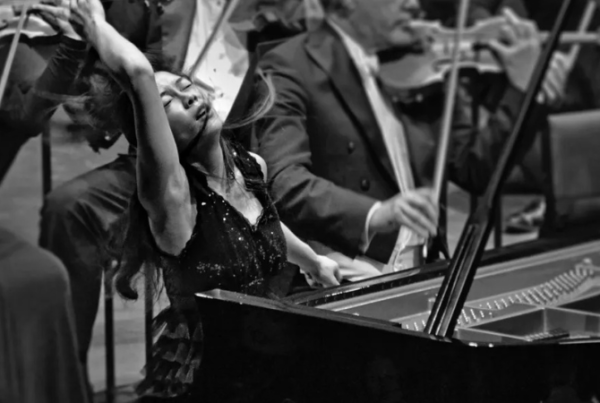
Flagstaff Symphony Orchestra’s final Season 76 concert is in collaboration with Northern Arizona University’s Shrine of the Ages Choir and Master Chorale of Flagstaff. They will be adding their vocal power to the incredible works on this concert’s program. One of those works for symphony and chorus is John Adams’s Harmonium. Below, you can read program notes for this piece, written by NAU choral conducting graduate student Marshall Voit.
John Adams (b.1947): Harmonium
Texts by John Donne (1572-1631) and Emily Dickinson (1830-1886)
Approximate duration: 35 minutes
Performing Forces: 4 flutes (3 doubling piccolo), 3 oboes, 3 clarinets (1 doubling bass clarinet), 3 bassoons (1 doubling contrabassoon), 4 horns, 4 trumpets, 3 trombones, tuba, timpani, percussion (bass drum, crotales, glockenspiel, metallophone, tubular bells, suspended cymbal, sizzle cymbal, crash cymbals, 2 marimbas, xylophone, triangle, tam-tams, anvil, cowbells, tambourine), harp, celesta, piano (or synthesizer), strings, and SATB chorus
When Harmonium premiered in 1981, audiences in San Francisco encountered something few had ever heard before: a choral symphony that blended elements of minimalism with the harmonic color and emotional depth of Romantic symphonic music. Commissioned by the San Francisco Symphony for the inaugural season of Davies Symphony Hall, and premiered under the baton of maestro Edo de Waart, Harmonium quickly established Adams as a central voice in modern American music. Today it stands as one of the most significant choral-orchestral works of the late twentieth century, a musical exploration of love, death, and ecstatic joy.
Born in 1947 in Worcester, Massachusetts, Adams grew up in a musical household; his father was a clarinetist and his mother a big-band singer. After studying composition at Harvard with Leon Kirchner and Roger Sessions, Adams moved west to teach at the San Francisco Conservatory of Music and immersed himself in the Bay Area’s experimental music scene. There, Adams heard the works of minimalist pioneers Steve Reich and Philip Glass for the first time, and while he was drawn to their style, he found their aesthetic “emotionally monochromatic.”1 Music critic and scholar Alex Ross writes that “when [Adams] heard the minimalism of Riley, Reich, and Glass, the pieces of his technique fell into place. He mapped fragments of romantic harmony onto the electric grid of minimalism.”2 In so doing, Adams’s process paralleled that of other minimalist composers such as Arvo Pärt (b.1935), John Tavener (1944-2013), and Caroline Shaw (b.1982), among others, who infuse the limited number of musical elements definitive of the genre with their own harmonic and technical vocabularies.
Adams described his own approach as “impure minimalism”; he borrowed the genre’s signature pulse but infused it with harmonic richness, dramatic contrast, and emotional volatility. “From the very start,” Adams wrote, “my own brand of minimalism began to push the envelope. What was orderly and patiently evolving in the works of Reich or Glass was in my works already subject to violent changes in gesture and mood.”3 By the late 1970s, Adams’s Phrygian Gates (1978) and Shaker Loops (1978) established Adams’s signature language of repetition, color, and harmonic expansion. With Harmonium (1980), Adams brought this idiom to life in large-scale choral-orchestral form for the first time. The result is a compelling work in which the steady pulse characteristic of minimalism blends with broad, expressive harmonies, and an element of drama that is rarely present in minimalist works.
Adams had originally planned to set poetry from Wallace Stevens’s collection Harmonium (1923) – hence Adams’s title – but instead turned to three poems of spiritual vision: John Donne’s “Negative Love” (1633) and Emily Dickinson’s “Because I Could Not Stop for Death” (ca. 1863) and “Wild Nights – Wild Nights!” (ca. 1861). Taken together, these three poems take the listener on a journey from love to mortality to ecstasy. Adams described “Negative Love” as a meditation on “the qualities of various forms of love, ascending in the manner of Plato’s Symposium, from the carnal to the divine.”4 Dickinson’s poems, by contrast, show two sides of the human spirit: one still and reflective, the other ecstatic with energy and desire. Adams chose these texts to realize a vision of “human voices – many of them – riding upon waves of rippling sound.”5
At its 1981 premiere, Harmonium astonished audiences and critics alike. For some, it represented a new synthesis of minimalism and symphony; for others, its slow pace felt static. In Fanfare (1985), Walter Simmons admired Harmonium’s “attractive aspects – certain moods, colors, and feelings” yet noted that “too little happens,” and called the words “completely inaudible.” Even so, he acknowledged Adams’s aim to conjure “a sense of vastness and eternity.”6 Over the decades, performers and listeners have learned to hear that expansiveness as the essence of the piece. The pulsing rhythm, slow harmonic shifts, and layered repetitions are not the ends, but the means by which Adams, as musical architect, constructed the work.
Harmonium has remained in the repertory of major symphony choruses for more than forty years, with notable performances by the Los Angeles Philharmonic, the BBC Symphony Chorus, and encores by the San Francisco Symphony. Recent performances reaffirm Harmonium’s importance and vitality. In 2024, Ludovic Morlot led the Seattle Symphony and Chorale in a performance that critic Thomas May praised as “a splendidly structured choral triptych that conveys states of transcendence, serene contemplation, and unbridled joy.”7 Four and a half decades after its premier, Harmonium still sounds like a journey of discovery.
On April 17, 2026, Harmonium will be presented collaboratively by the Flagstaff Symphony Orchestra, the Flagstaff Master Chorale, and Northern Arizona University’s Shrine of the Ages and Vox Montes choirs, conducted by Dr. Timothy Westerhaus. As you listen, think of Harmonium not as three distinct movements but as one expansive landscape of sound, painted in three brush strokes. In the first, listen for how a single pitch accumulates momentum and slowly blooms into rich harmony, a metaphor for expansive and expanding love. In the second, notice how harmonic shifts and orchestral texture create a sense of suspended time. In the third, let the waves of rhythm and shifting harmonies carry you through turbulence into calm. Adams said he hoped performances of Harmonium would feel like “traveling – sometimes soaring, sometimes barely crawling – but nonetheless always moving forward over vast stretches of imaginary terrain.”8
Movement I: Negative Love
The opening of Harmonium is one of the great soundscapes in modern choral music. It begins almost imperceptibly: a single D above middle C pulses in the chorus, supported by flutes sustaining the same pitch. Soon, Adams layers other tones that slowly thicken the harmony. He called this process “accretion”: a single note “becomes a tone cluster, then a chord, and eventually a huge, calmly rippling current of sound that takes on energy and mass.”9 At first, the texture is translucent: long-held notes hover over an undulating pulse. As new pitches enter, cluster chords form and resolve in slow motion, the harmonic rhythm more undulating than metrical. Over these waves, fragments of Donne’s text surface: “I can love neither with the love of the youth nor the love of the aged.”
The chorus’s words are less declaimed than woven into the orchestral texture; language itself becomes part of Adams’s larger soundscape. As the movement gains momentum, rhythmic layers accumulate: sustained string tones, syncopated brass, shimmering percussion. Though the pulse stays steady, energy intensifies. By the climax – an immense fortissimo on “If any who deciphers best what we know not, ourselves, can know…” – chorus and orchestra rise together, then subside in inevitable return to the opening D, the pulse still beating.
Movement II: Because I Could Not Stop for Death
If Harmonium’s first movement expands outward, its second movement turns inward. Written around 1863, Dickinson’s poem personifies Death as a courteous suitor who “kindly stopped” for the speaker, carrying her “toward eternity.” Adams called this movement “a sequence of images from a short life, a kind of pastoral elegy expressed through the lens of a slow-motion camera.”10 The orchestral fabric is hushed: soft, slowly pulsing strings suggest motion without urgency, as harp, celesta, and percussion punctuate the texture. The chorus enters softly in parallel octaves, and continues, hymnlike, in mostly homophonic rhythm. Moments of counterpoint and one stark moment of a cappella singing draw the audience in. Harmony shifts infrequently but decisively, with minor and modal sections evoking shadow and light. Phrase lengths expand and contract, blurring the listener’s sense of meter. Near the end, the harmonic and textual rhythm quickens, dynamic range swells, drama builds, and a bridge forms, “a kind of bardo stage between the end of one life and the beginning of a new one… the music gradually assumes weight, force, and speed until it is hurled headlong” into the final movement.11
Movement III: Wild Nights – Wild Nights!
Written around 1861, Dickinson’s “Wild Nights” is passionate and ecstatic, with “a poetic intensity that is at once violent and sexual.”12 Adams described his third movement as a “bright, vibrant clangor,” with sudden key changes that act as “celestial gear shifting.”13 The movement begins with a unison choral exclamation – “Wild Nights! Wild Nights!” – punctuated by brass and percussion. Strings move in perpetual motion while woodwinds spin overhead. Energy bursts outward, then folds back in. Meters and textures are layered against each other. Harmonically, Adams propels the music through a series of quick modulations, which Adams calls “gates,” each one brighter than the last, “abrupt transitions that act like a continuously accelerating centrifuge.”14 The movement reaches its climax as layers of rhythm and harmony collide in brilliant dissonance, then quickly recede. The pulse returns. The texture slowly thins
and fades. The final chord lingers – clear, but unresolved – suggesting that the journey continues, even after the piece concludes.
Across its three movements, Harmonium invites the listener into a musical world where small changes carry great weight. Guided by texts that explore love, mortality, and longing, the piece develops as an experience to be savored immersively rather than observed from a distance. It is music that rewards patience, inviting the listener to remain present as sound, text, and harmony gradually unfold.
Written by: Marshall Voit
Marshall Voit is a graduate student in choral conducting at Northern Arizona University, conducts NAU’s University Singers, and sings bass with Los Bordershop barbershop quartet.
1 David Smith, “Not a Political Composer: An Interview with John Adams,” Bachtrack, January 18, 2017, https://bachtrack.com/interview-john-adams-jan-2017.
2 Alex Ross, “The Harmonist: John Adams Takes the Agony out of Modern Music,” The New Yorker, January 1, 2001, accessed October 20, 2025, https://www.newyorker.com/magazine/2001/01/08/the-harmonist.
3 John Adams, “Harmonium,” Hollywood Bowl, accessed October 18, 2025,
https://www.hollywoodbowl.com/musicdb/pieces/382/harmonium.
4 Ibid.
5 Ibid.
6 Walter Simmons, “Adams: Harmonium,” Walter Simmons, accessed October 25, 2025, https://walter-simmons.com/writings/1679.
7 Thomas May, “Adams’s Early Masterwork ‘Harmonium’ Strikes a Chord in Seattle,” Memeteria, June 17, 2024, accessed October 20, 2025, https://memeteria.com/2024/06/17/adamss-early-masterwork-harmonium-strikes-a-chord-in-seattle/.
8 John Adams, “Harmonium,” Wise Music Classical, accessed October 25, 2025,
https://www.wisemusicclassical.com/work/23705/Harmonium–John-Adams/.
9 John Adams, “John Adams on Harmonium,” Earbox, accessed October 25, 2025, https://www.earbox.com/harmonium/?.
10 Ibid.
11 Adams, Hollywood Bowl.
12 Adams, Wise Music Classical.
13 Adams, Hollywood Bowl and Adams, Wise Music Classical.
14 Adams, Wise Music Classical.